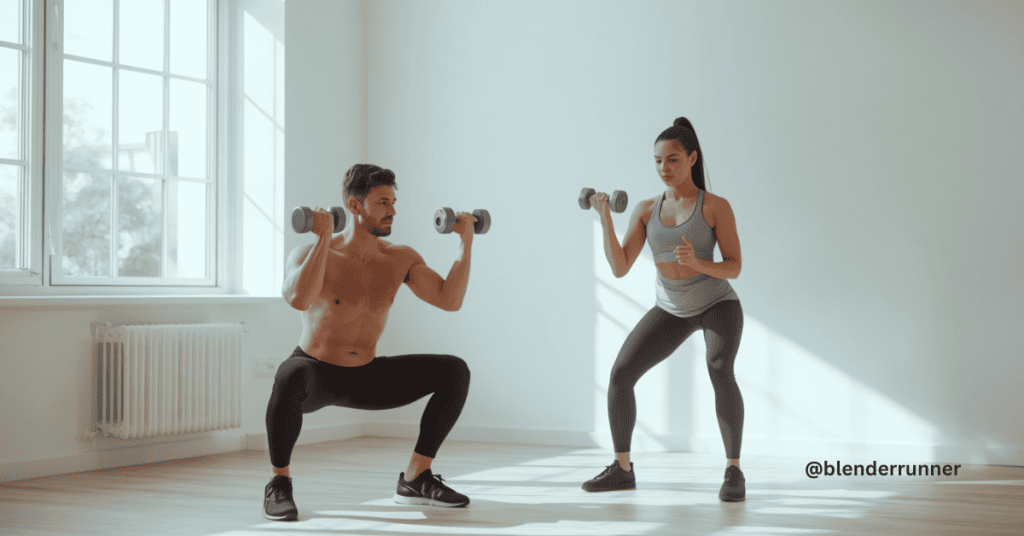
Strength training for beginners doesn’t need to start in a gym, and it definitely doesn’t need to start with a barbell. If you’ve never lifted anything heavier than shopping bags before, the good news is that your body responds to almost any added resistance at first — meaning the simplest possible starting point is also a genuinely effective one.
This guide covers exactly where to start with strength training for beginners: the moves worth learning first, how often to train, what equipment (if any) you actually need, and the mistakes that trip up almost everyone in their first few months.
Quick answer: start with bodyweight squats, push-ups, glute bridges, and rows using a resistance band or light dumbbells, training 2-3 times a week with a day of rest between sessions. Add weight or reps gradually once the current level feels easy.
🏋️ Strength Training for Beginners: The First 4 Moves
These four moves cover the major muscle groups and form the foundation almost every strength programme is built on. Learn these properly before adding anything more complex.
1. Bodyweight Squat
Feet shoulder-width apart, lower your hips back and down as if sitting into a chair, keeping your chest up, then drive back to standing. This is the foundation move for leg and glute strength, and it’s exactly where strength training for beginners should start before adding any external weight.
Starting point: 3 sets of 10-12 reps
2. Push-Up (or Knee Push-Up)
Hands slightly wider than shoulder-width, lower your chest toward the floor keeping your body in a straight line, then push back up. Dropping to your knees is a completely valid regression while you build the strength for a full push-up — there’s no shortcut version that “doesn’t count.”
Starting point: 3 sets of 6-10 reps
3. Glute Bridge
Lie on your back, knees bent and feet flat on the floor, then lift your hips toward the ceiling by squeezing your glutes, pausing briefly at the top. This strengthens the glutes and lower back, both of which tend to be weak points for people who sit most of the day.
Starting point: 3 sets of 12-15 reps
4. Resistance Band Row
Anchor a resistance band at chest height (or loop it around a sturdy door handle), then pull the band toward your torso, squeezing your shoulder blades together. This is the one pulling movement in the routine and balances out all the pushing work from the push-up.
Starting point: 3 sets of 10-12 reps
📋 Strength Training for Beginners — Weekly Starting Plan
| Day | Focus | Notes |
|---|---|---|
| Monday | Full body (all 4 moves) | 3 sets each, moderate effort |
| Tuesday | Rest or light walking | Recovery day |
| Wednesday | Full body (all 4 moves) | Aim to match or slightly beat Monday |
| Thursday | Rest or light walking | Recovery day |
| Friday | Full body (all 4 moves) | 3rd session of the week |
💪 Why Beginners Get Results Fast
One of the most encouraging things about strength training for beginners is how quickly early progress shows up. Your nervous system gets more efficient at recruiting muscle fibres within the first few weeks, well before any visible muscle growth — which is why beginners often find they can lift more or do more reps surprisingly fast.
According to the NHS’s official guidance on strength and flexibility exercises, adults should aim for muscle-strengthening activity on at least two days a week, working all the major muscle groups — which is exactly what a simple full-body routine like this one is designed to cover.
Sticking with a consistent, simple routine for the first few months matters more than finding the “optimal” programme. Strength training for beginners is far more about showing up regularly than it is about getting every set perfectly optimised from day one.
🛠️ Equipment Options as You Progress
Bodyweight alone will carry you through the first several weeks, but at some point squats and push-ups stop providing enough of a challenge. That’s the natural moment to introduce a bit of external resistance, and there’s no need to overspend to do it.
- Resistance bands — the cheapest and most compact option, useful for rows, added squat resistance, and travel
- Adjustable dumbbells — a bigger upfront cost but far more versatile long-term than fixed-weight pairs, since one set covers years of progression
- A single kettlebell — good for adding load to squats and introducing swings and other hinge movements once the basics feel solid
- A pull-up bar — worth adding once bodyweight rows with a band start feeling too easy, as a natural progression for back strength
None of this needs to happen in the first month. Most beginners get several weeks of genuine progress out of bodyweight training alone before any equipment purchase becomes necessary, so there’s no pressure to buy anything before you’ve even started.
⚠️ Common Mistakes to Avoid
A handful of habits trip up most people starting strength training for beginners. Avoiding these matters more than any specific programme choice:
- Adding weight too quickly — form breaking down under too much load is the fastest route to injury; increase weight only once the current load feels genuinely easy
- Skipping rest days — muscles grow stronger during recovery, not during the workout itself, so training the same muscles every single day slows progress rather than speeding it up
- Comparing your week 1 to someone else’s year 3 — social media makes advanced lifting look like the starting point; it isn’t, and it never was for anyone
- Neglecting the “boring” moves — squats, push-ups, and rows aren’t glamorous, but they build far more real-world strength than isolation exercises ever will for a beginner
- Training through sharp pain — mild muscle fatigue is normal; sharp or joint pain is not, and pushing through it usually turns a minor issue into a longer setback
If you have an existing injury, a heart condition, or haven’t exercised in a long time, it’s worth checking with a doctor before starting a new strength training routine — most of these moves can be scaled down safely, but it’s worth confirming for your specific situation.
Recommended Fitness Essentials
A few simple tools that make strength training for beginners easier to progress:
- Adjustable Dumbbells — perfect for home workouts and progressive strength training as bodyweight starts to feel easy
- Resistance Bands Set — ideal for the row, and useful for adding resistance to squats too
- Non-Slip Yoga Mat — comfortable cushioning for glute bridges and floor-based moves
- Kettlebell (8–12kg) — a natural next step once the four foundational moves feel comfortable
- Foam Roller — helps with recovery and muscle tension between sessions
Browse options on our Amazon fitness essentials store.
📘 Want a Full Structured Plan to Follow?
These four moves are a genuinely solid starting point, but a structured plan takes the guesswork out of when to add weight, reps, or new exercises. Our Home Workout Guide covers exactly that — simple, equipment-light routines built to progress with you as you get stronger.
❓ Frequently Asked Questions
Do I need a gym membership to start strength training?
No. Strength training for beginners can genuinely start with just bodyweight and a resistance band at home — a gym only becomes useful once you want more variety or heavier weights than home equipment allows.
How sore should I expect to be after starting?
Some muscle soreness in the first 1-2 days is normal and usually fades within a week as your body adapts. Sharp pain, joint pain, or soreness that doesn’t improve is different and worth getting checked.
How long until I see results?
Strength improvements often show up within 2-4 weeks, since your nervous system adapts before visible muscle changes appear. Visible changes typically take 8-12 weeks of consistent training.
Can women and men follow the same beginner routine?
Yes. The fundamentals of strength training for beginners don’t differ by gender — everyone benefits from the same foundational moves, progressing at whatever pace suits their current starting point.
🔥 Recommended Health & Fitness Products
These products can support your weight loss, energy, and overall wellness journey alongside a new strength training habit:
Ikaria Lean Belly Juice
A natural formula designed to support metabolism and energy.
👉 Learn more
LeanBiome
A gut-health focused supplement that may help with cravings and weight management.
👉 Learn more
The Smoothie Diet (21-Day Program)
A simple, beginner-friendly plan that uses smoothies to support weight loss and better nutrition.
👉 Learn more
🔥 Final Thoughts
Strength training for beginners doesn’t need to be complicated to work. Four foundational moves, three sessions a week, and a bit of patience with adding weight or reps is genuinely enough to build real, lasting strength — no gym membership or expensive equipment required to get started.
Start with the plan above, stick with it consistently for a month, and adjusting from there becomes far easier once you’ve actually got a baseline to build on.
🏋️ Related Guides
This post may contain affiliate links. I may earn a small commission at no extra cost to you.
